
AI & LUA Scripting Reshape: Website Backend Data Entry Optimization for SEO Growth
Have you invested significant effort in creating high-quality content, only to find its performance on your website mediocre, failing to deliver the expected traffic and conversions? The issue might not be the content itself, but the “last mile” publishing process from document to webpage. This article delves into how traditional content management acts as an “invisible constraint” on your website’s growth, and reveals how d2h.pro, through AI-driven automation and custom LUA scripting, awakens your content to become a core engine for SEO growth.
Introduction: The “Hidden Iceberg” of Content Management
Imagine a scenario: Your marketing team spends weeks planning and drafting a series of in-depth industry reports. The content is detailed and insightful. However, when these valuable Word documents are handed over to the website editor, an invisible “disaster” begins. Editors spend days, or even weeks, manually copying, pasting, adjusting formats, uploading images, setting table styles… This process is not only immensely time-consuming but also prone to errors. The final content published on the website is often poorly formatted, offers a terrible mobile experience, and worse, search engines seem to ignore it.
This is not an exaggeration, but the daily reality faced by countless businesses. We focus on creation (What to say), but often neglect publication (How to show). The gap from “Document” to “Webpage” (HTML) is the key source of content value loss and suppressed SEO potential. Today, we will uncover this iceberg and confront the “silent killers” that are stifling your website’s growth.
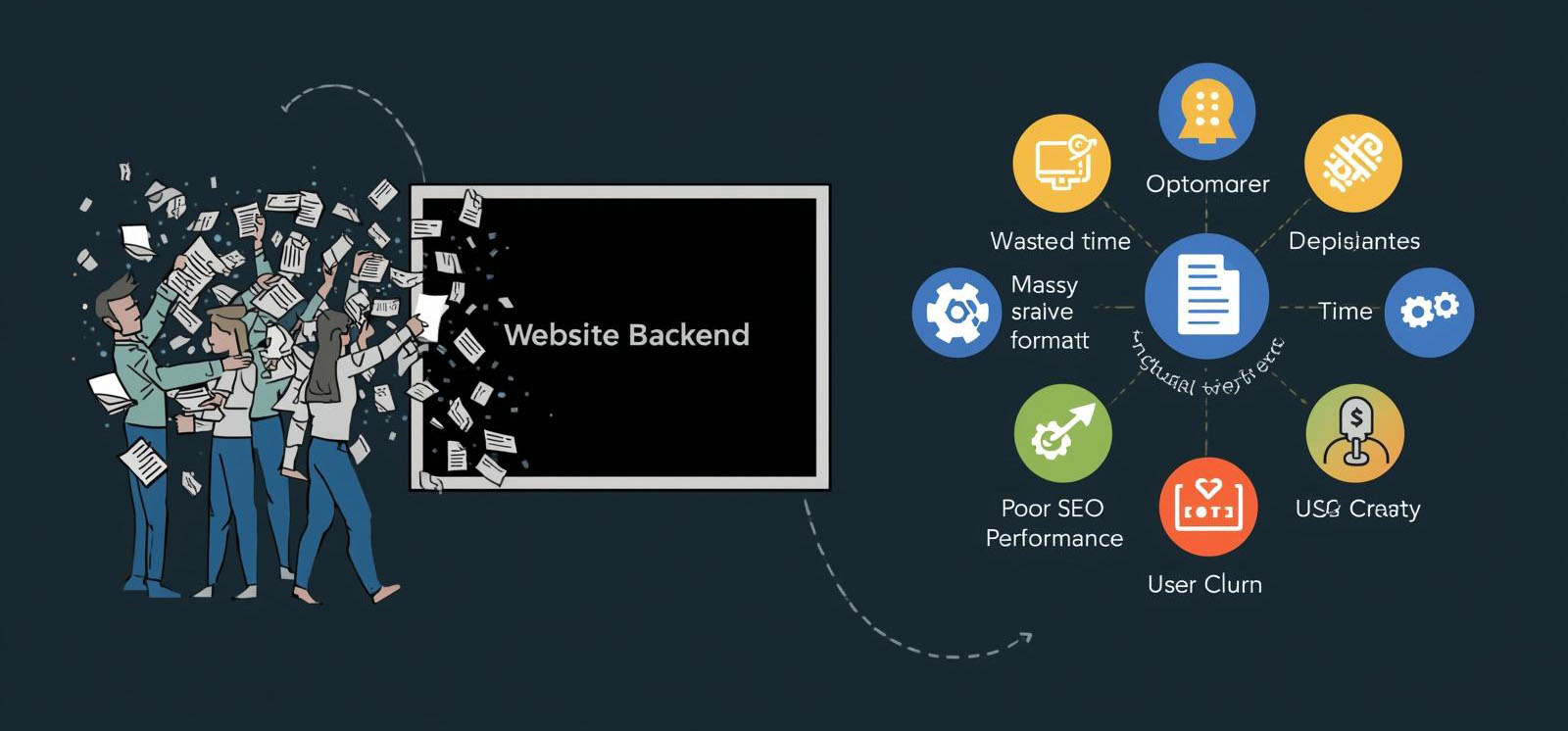
Part One: Four Core Content Management Pain Points Killing Efficiency and Growth
At d2h.pro, we collaborate with numerous enterprises, news portals, and e-commerce platforms, and we’ve found that regardless of the industry, inefficient content management processes consistently lead to the following four core pain points:
1. The “Time Sink” of Manual Entry and High Hidden Costs
This is the most obvious pain point. Manually migrating content from documents to the website backend is an extremely repetitive, tedious, and uncreative task. It not only directly consumes the team’s valuable time (which could have been used for content strategy or creative ideation) but also incurs high hidden costs—the error rate. An incorrect format, a missing link, or an uncompressed image can all lead to a poor user experience and SEO penalties.
2. The “Visual Disaster” of Inconsistent Formatting and Erosion of Brand Image
When multiple editors, or even employees from different departments, maintain a website together, the lack of unified standards results in content presentation being highly inconsistent. Some headings are bold, others are not; some images are centered, others are left-aligned; table styles are wildly varied. This visual inconsistency not only looks unprofessional but also gradually erodes user trust in your brand. How can users trust the quality of your product or service if your website content layout is inconsistent?
3. The SEO Ceiling Caused by “Lack of Structure”
Search engines (like Google) increasingly resemble a meticulous librarian; they favor pages with clear structure, standardized tags, and consistent content. If your article merely “dumps” text and images onto a webpage, lacking proper heading hierarchy (H1, H2, H3), Structured Data (Schema markup), and unified internal linking logic, then in the eyes of a search engine, it is an “unintelligible book of garbled code.” This means that no matter how well-written your content is, it will struggle to achieve good rankings, and your investment in creation is thus wasted.
4. The “Scaling Bottleneck” That Prevents Expansion
For news portals, e-commerce platforms, or large knowledge bases, scaled content publishing is a core necessity. Updating hundreds of news items daily or launching thousands of products (SKUs) at once is nearly impossible through manual operation. This “scaling bottleneck” severely limits business expansion speed, causing you to miss opportunities in a rapidly changing market.
Part Two: D2H.pro’s Solution: AI + LUA Scripting, Reshaping Your Content Publishing Engine
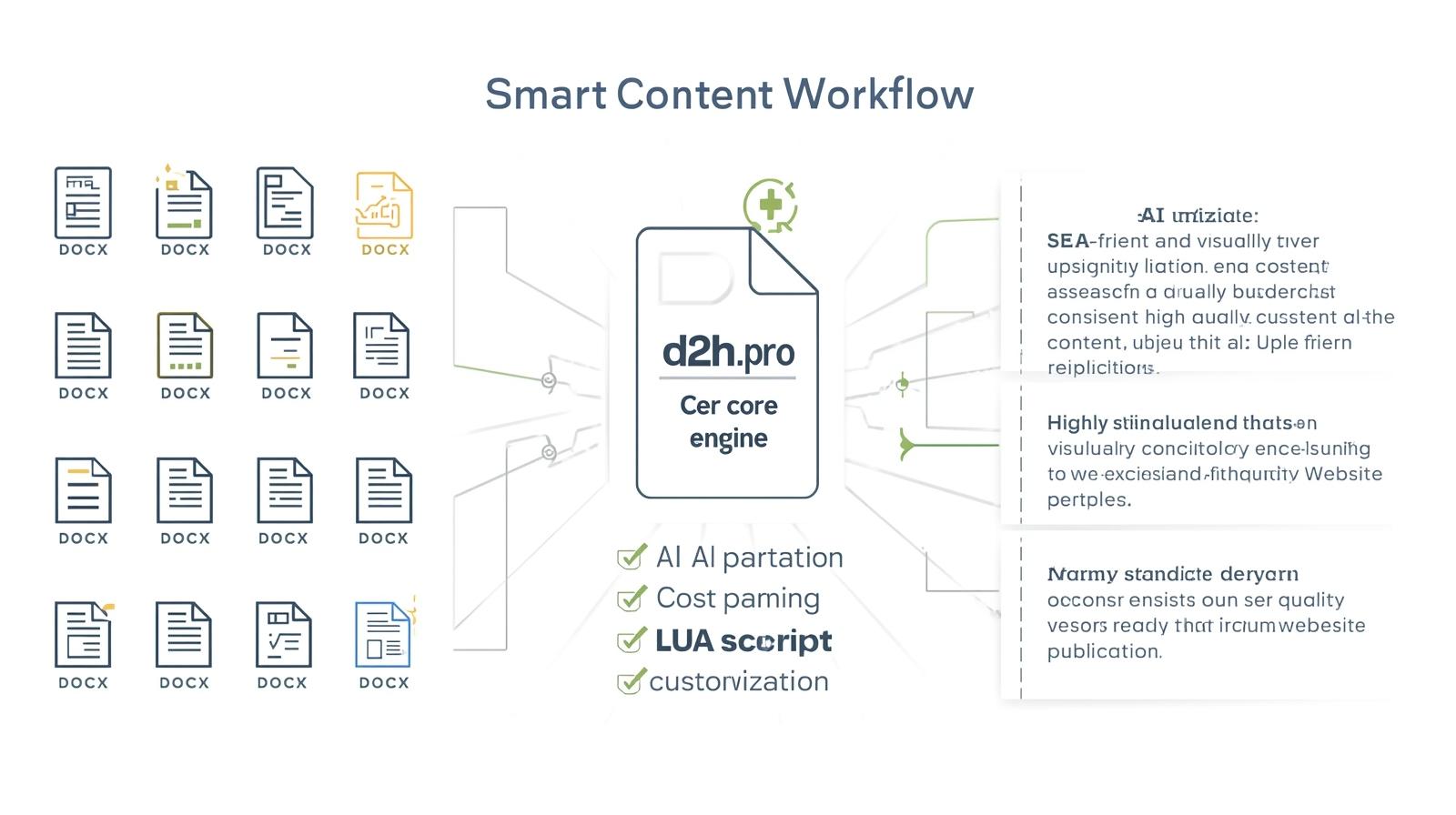
Recognizing the severity of the problem, the real challenge lies in finding a solution. D2H.pro’s answer is not simply to “speed up manual work,” but to fundamentally reshape the process. Our core solution is the combination of **”AI-Driven Automation” and “Precise LUA Script Customization”**, which together form a powerful and flexible content publishing engine.
1. Intelligence-Driven for Both Efficiency and Precision: Application of AI Tools (Trae, MCP)
We do not simply use AI for content spinning or writing, but deeply integrate it into the engineered content entry process. We incorporate next-generation AI tools like Trae and MCP, which are responsible for end-to-end optimization, from data collection and content parsing to automated entry.
How Does It Work? You only need to provide the source document (e.g., .docx). Our AI tools automatically parse its structure, identify elements like headings, paragraphs, lists, images, and tables, and convert them into a standardized data format. This process is not only extremely fast but, more importantly, ensures data consistency and accuracy, eliminating errors that manual operation might introduce at the source.
2. Customized Logic, Flexible for Complex Scenarios: The Power of LUA Script Programming
If AI solves 80% of the standardization issues, LUA scripting perfectly addresses the remaining 20% of complex and personalized requirements. LUA is a lightweight, high-efficiency scripting language that allows us to provide you with highly controllable, customized processing capabilities.
Example Application Scenarios:
- Precise Style Adaptation: Your brand guidelines require all hyperlinks to be a specific blue, and table headers to have a special background color. Through LUA scripting, combined with the color specifications generated by the Adobe Color system, we ensure that 100% of the entered content complies with your visual identity (VI).
- Handling Special Formats: Your documents contain complex mathematical formulas or code blocks that require specific front-end rendering. LUA scripts can precisely identify and apply the corresponding display logic.
- Automated SEO Operations: When entering content, automatically generate **ALT tags** for images based on the title and keywords, or automatically add relevant internal links based on the article content.
3. Unified Architecture for Standardized Presentation: Modular Templates and Global Controls
We firmly believe that all technology must ultimately serve presentation. To this end, we design based on modular website templates and global controls. This means that regardless of who enters the content or when, the final presentation on the website will maintain a unified structure and visual standard. This not only guarantees the platform’s professional image but also significantly enhances the website’s SEO friendliness due to its high degree of structure and standardization.
Part Three: From Theory to Practice: What Does This Mean for Your Business?
Our solution is not an empty technical concept; it brings tangible business value to different types of websites:
- For News Portals and Knowledge Bases: You will have an “automated editorial team” capable of 24/7, high-standard content output, easily handling massive, long-cycle content update needs, ensuring information timeliness and authority.
- For E-commerce and Cross-Border Platforms: You can achieve bulk, rapid, and standardized entry of thousands of product detail pages. Combined with LUA scripting, content can be localized for different national markets (e.g., currency symbols, unit sizes), greatly improving global operation efficiency.
- For Corporate Websites: You will permanently eliminate content format chaos caused by employee turnover or improper operation. Every content update will be a reinforcement of your brand image, building stronger professional trust with clients.
Conclusion: Don’t Let the Content Publishing Process Be the Last Shortcoming in Your Digital Transformation
In this age where content is king, the ability to manage content efficiently, precisely, and with standardization is no longer a “bonus” but a “necessity” that determines success or failure. It directly impacts your SEO performance, user experience, brand image, and operational efficiency.
Manual, inefficient publishing methods are allowing the high-quality content you create to “sleep” in the corners of your website. It’s time to wake them up with smarter methods. D2H.pro is committed to being your “SEO Growth Technology Partner,” using our unique “AI + Code” solution to bridge the gap from document to webpage, ensuring every piece of your content is presented in its optimal state, unleashing its full potential, and driving sustained business growth.
Ready to start your intelligent content management journey? Contact us now to get a customized website content process optimization plan tailored for you.
FAQ
- Why does the traditional manual content publishing method limit a website’s SEO potential?Traditional manual content publishing creates multiple issues that collectively form an “invisible constraint” limiting SEO: Lack of Structured Markup: Manually “dumped” content often lacks standardized heading hierarchy (H1, H2, H3) and Structured Data (Schema markup). In the eyes of search engines (like Google), this content is an “unintelligible book of garbled code,” making it difficult to achieve good rankings. Low User Experience (UX) due to Inconsistent Formatting: Poorly formatted content with a bad mobile experience leads to lower user engagement. Search engines factor user experience into rankings, so user loss indirectly leads to SEO penalties. Inefficient and Error-Prone Process: Manual entry is susceptible to format errors, missing links, or uncompressed images, all of which are technical errors that affect page load speed and overall SEO performance.
- How does the “lack of structure” mentioned in the article affect my content rankings?Search engines increasingly resemble a meticulous librarian, favoring pages with clear structure, standardized tags, and consistent content. If your article lacks the correct heading hierarchy, Structured Data markup, and unified internal linking logic, it is difficult for search engines to quickly and accurately understand your content’s core meaning. This is like a book without a table of contents or index; no matter how well-written the content is, it struggles to be effectively categorized and recommended by the “librarian,” causing your creative investment to be wasted.
- How does d2h.pro’s content publishing engine help me improve SEO friendliness?D2H.pro’s core solution is the combination of “AI-Driven Automation” and “Precise LUA Script Customization,” fundamentally ensuring the standardization and structure of content output, which is key to boosting SEO: Standardized Structure: AI tools (like Trae, MCP) automatically parse the source document, converting elements like headings and paragraphs into a standardized data format. This guarantees data consistency and accuracy, eliminating structural errors that manual operation might introduce. Unified Presentation Architecture: Designed based on modular website templates and global controls, the content presentation on the website maintains a unified structure and visual standard regardless of who enters it, significantly enhancing the website’s SEO friendliness. Automated SEO Operations: LUA scripts enable customized SEO operations, such as automatically generating image ALT tags based on titles and keywords, or automatically adding relevant internal links based on article content.
- What are the specific applications of LUA scripting in SEO optimization?LUA scripting resolves the remaining complex and personalized needs in the automation process. In terms of SEO, its applications include: Automated Internal Linking: During content entry, LUA scripts can automatically identify keywords in the article and add internal links pointing to other relevant pages within the site, strengthening the website’s link structure and page authority flow. Image ALT Tag Generation: Automatically generate standardized, descriptive ALT tags for uploaded images based on the article title and preset keywords, improving image visibility in search results. Special Format Optimization: Handle complex mathematical formulas or code blocks, ensuring they are correctly parsed and indexed by search engines, rather than being treated as plain text.
- How does automated content publishing help large websites (like news portals) solve the “scaling bottleneck” and boost SEO?For large websites requiring massive, high-frequency updates, such as news portals or e-commerce platforms, the “scaling bottleneck” is the core issue limiting growth. D2H.pro’s solution provides an “automated editorial team” capable of 24/7, high-standard content output. This capability easily handles the bulk, rapid, and standardized entry of hundreds of news items or thousands of products (SKUs) daily. SEO Advantage: The speed of scaled publishing and the standardized structure mean that large amounts of new content are quickly crawled and indexed by search engines in their optimal, most standardized state, ensuring the information’s timeliness and authority—which is critical for news or knowledge base websites to achieve high rankings.
Products
-
 Single Pattern Layout
Original price was: $2.00.$0.55Current price is: $0.55.
Single Pattern Layout
Original price was: $2.00.$0.55Current price is: $0.55.
-
 Lua Script Customization Development
Original price was: $200.00.$150.00Current price is: $150.00.
Lua Script Customization Development
Original price was: $200.00.$150.00Current price is: $150.00.
-
 10 Content Data Entry
Original price was: $50.00.$45.00Current price is: $45.00.
10 Content Data Entry
Original price was: $50.00.$45.00Current price is: $45.00.
-
 Single Content Data Entry
Original price was: $7.00.$4.50Current price is: $4.50.
Single Content Data Entry
Original price was: $7.00.$4.50Current price is: $4.50.